Every flu season brings a sense of déjà vu: Patient volumes surge, testing demand skyrockets and clinics stretch their capacity to the limit year after year. Once case numbers decline, urgency fades until the next wave inevitably arrives.
Interestingly, since the end of the COVID-19 pandemic, the post-cold/flu season decline in URI cases has been less dramatic and shorter lived — with a spike in URI cases (mostly COVID-19) seen in the fall leading directly into the next cold/flu season. One could say that the world will always be in a continuous URI cycle, with only short breaks in between.
Treating seasonal spikes as isolated crises traps healthcare systems in a reactive cycle rather than a proactive one. But learnings from recent “tripledemics” of flu, RSV and COVID-19 can inform a more sustainable model for upper respiratory infection (URI) monitoring and management.
It all starts with improving specimen collection methods to become more comfortable, sensitive and scalable — now. Explore how one emerging solution, evolved nasal lavage, is well-positioned to strengthen outbreak response year-round and minimize the repeat strain of the season reactive cycle.
Lessons from Recent ‘Tripledemics’ Make the Case for Change
Flu, COVID-19 and RSV in the post-pandemic era are now overlapping endemic infections, rather than one-off events. Because URIs are now spread more evenly across the season with fewer and less pronounced infection spikes, this helps alleviate testing infrastructure burden. In the 2024–25 season, the Centers for Disease Control reported the following case estimates:
- Influenza: Up to 1.3 million hospitalizations and 130,000 deaths among the potential 82 million Americans infected
- COVID: Up to 540,000 hospitalizations and 63,000 deaths, most commonly impacting older and immunocompromised adults
- RSV: Up to 250,000 hospitalizations and 23,000 deaths, disproportionately affecting infants
When these viruses peak at once, healthcare environments face acute demand for hospital beds, staff and diagnostic testing, but often lack the infrastructure and resources to keep up. Testing volume surges only after cases rise, and issues with specimen quality can slow results, delay treatment and amplify costs.
Much of this stems from outdated collection methods. The default nasal swab, while familiar, is uncomfortable, has inconsistent collection techniques and is prone to false negatives. From poor specimen testing sensitivity to patient and provider testing aversion and the potential for swab related patient injuries, these challenges contribute to diagnostic errors occurring in roughly 15% of all URI cases, according to multiple academic studies.
To avoid wasting valuable time and resources and to better manage surges, we must move beyond legacy tools. Reassessing our specimen collection methods is the first critical step.
Scalable to the Seasons: Why Nasal Lavage Is Built for Cyclical Surges
URI spikes tend to hit hardest when healthcare systems are already stretched thin, making it essential for sampling solutions to deliver consistency and accuracy across every surge, every season.
Unlike swab-based methods, evolved nasal lavage offers a virtually pain-free, consistently reproducible experience that people are more willing to undergo earlier and, if needed, more often — encouraging proper diagnoses during the ideal therapeutic treatment window within 3 to 5 days of symptom onset.
The right solution also simplifies storage. Nasal lavage kits with extended shelf life can be stockpiled and deployed rapidly when respiratory cases surge. Scalability empowers health systems to minimize disruptions and sustain lab throughput during seasonal cycles.
Simplified Nasal Lavage Integration for Today’s Workflows
The optimal specimen collection solution should use the same PCR infrastructure already in place for respiratory testing, requiring no new instruments or major process changes. Seamlessly integrated into current respiratory panels, evolved nasal lavage offers flexibility to enhance sample quality without disrupting established protocols.
From a financial standpoint, certain lavage devices carry defined reimbursement pathways for specimen collection, helping offset implementation costs and incentivizing broader adoption. Together, these advantages make evolved nasal lavage a simple, practical upgrade.
Extended Reach Among Assisted Care & High-Risk Groups
For those most vulnerable to URIs — older adults, young children and people with chronic conditions — safe and frequent testing is even more vital. It’s important to note that when you add up these at-risk groups in the U.S., the total is over 200 million people or almost 60% of the population. Early testing and treatment can minimize unnecessary healthcare utilization, such as emergency department visits, hospital admissions or even death.
Assisted care sampling using evolved nasal lavage expands access beyond traditional clinical settings and into long-term care facilities, urgent care centers and community health programs.
The process gently flushes sterile saline through the nasal cavity instead of ramming a swab into it, reducing discomfort and anxiety for patients who may otherwise avoid testing. This is especially important among older adults, where one hospitalization can compound into long-term decline.
Smarter Sampling Breaks Testing Fatigue Cycles for Healthcare Providers
Every test begins and ends with healthcare professionals, who remain at the center of the tripledemic season cycle:
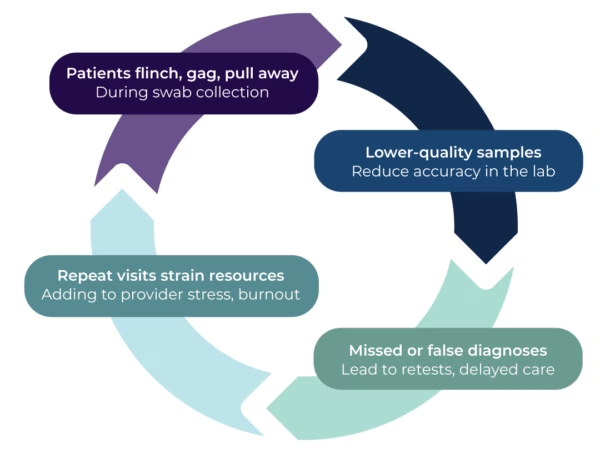
Each step in the cycle amplifies the next, until sampling methods evolve to break it. Nasal lavage does just that with a smoother collection process producing high-sensitivity specimens to get it right the first time — meaning fewer diagnostic errors, faster results and more timely patient treatment.
Shift the Narrative from Crisis Response to Sustainability with MicroWash
Respiratory testing has long operated in crisis mode, reacting to each surge instead of preparing for the next. Healthcare systems need a better option that strengthens readiness year-round.
The MicroWash nasal lavage specimen collection device is an ideal solution, delivering:
- More Sensitive Samples: MicroWash samples plus PCR tests are up to 49% more sensitive than swabs coupled with antigen tests.
- Comfortable Experience: In terms of pain, patients rate swabs at 8/10 and MicroWash at just 0.3/10, supporting increased willingness to test.
- Longer Shelf Life: Nasal swabs kits generally expire after one to two years, while MicroWash kits have up to a three-year shelf life.
- Easy Lab Integration: The device seamlessly integrates into existing PCR protocols.
- Reimbursement Pathway: A reimbursement pathway for MicroWash sample collection has been identified, further improving widespread access and affordability of the kits.
Discover more advantages of MicroWash over nasal swabs and contact our medical experts to equip your healthcare environment with the future of “tripledemic” URI sampling.