Not all nasal samples are created equal. Where and how we collect pathogen-containing material for upper respiratory infection (URI) testing can make all the difference between a confirmed infection and a missed case.
The crux of a “good” versus “bad” sample? Its sensitivity, or ability to identify the pathogen causing a URI. Low sensitivity — often seen with nasal swab samples — can lead to higher rates of false negatives, delaying medication intervention and potentially exposing others to the virus. In high-risk patients (i.e., people 65 and older, 5 and under or with a chronic disease), timeliness is critical for preventing hospitalization and/or death.
Evolved nasal lavage addresses these issues head-on, delivering 11% to 49% greater sensitivity compared to nasal swabs. Dive into how this solution outperforms swabs and why it matters, from anatomical differences to the amount of pathogen-containing material captured.
Anatomy Matters: Reaching Where the Virus Really Lives
Sensitivity starts with how the sample is collected, the goal being to gather specimen from wherever the virus has the highest concentration. In this case:
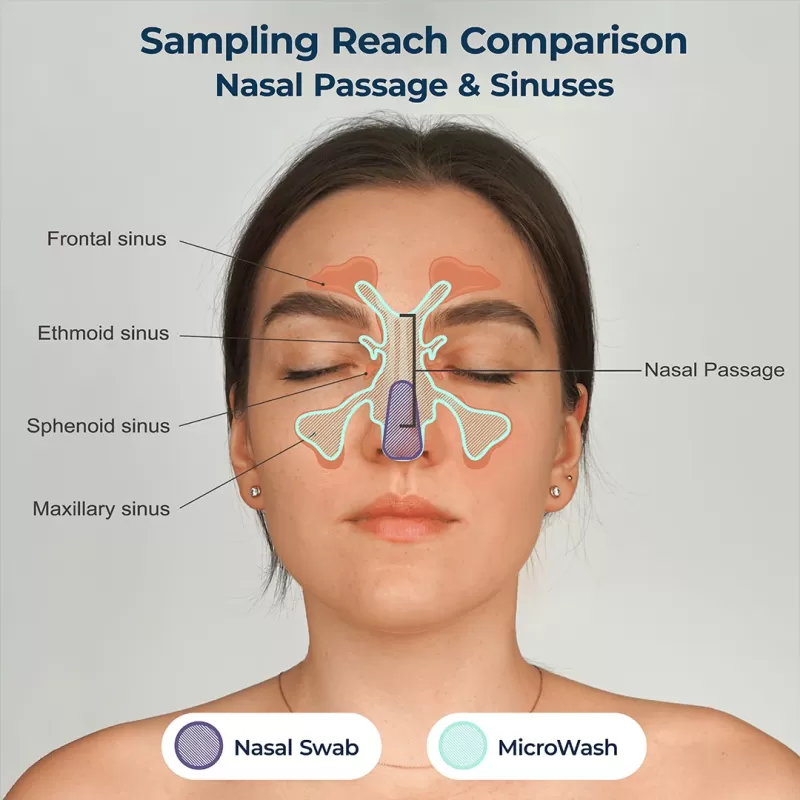
- The upper nasal cavity and sinuses carry the vast majority of pathogen load. Studies show high URI pathogen concentrations in the upper nasal cavity and particularly the olfactory epithelium, which includes the upper nasal passages and the frontal, maxillary and ethmoid sinuses.
- The lower and mid nasal passages carry lesser amounts of the pathogen. URI pathogens, although still present in these areas, are at much lower concentrations — increasing the chance of a false negative PCR test.
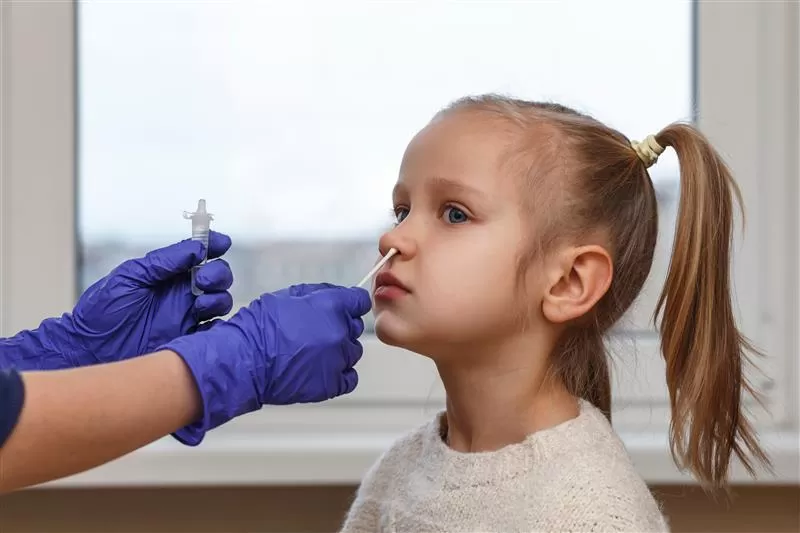
This is where nasal swabs fall short. At-home tests often barely reach past the nostril, which makes sense. Going any higher is quite uncomfortable and relies on a person’s ability to suppress their own gagging and sneezing, and willingness to inflict pain on themselves, to perform the test properly. Even in drive-throughs or clinical settings, tests don’t go much further, stopping at the mid-nasal passage to avoid risking injury and patient discomfort.
Nasal washes, on the other hand, use liquid saline to infiltrate those hard-to-reach areas without the discomfort. This includes the upper nasal cavity, ethmoid sinuses, maxillary sinuses and the proximal region of the frontal sinuses. To better visualize the difference in surface area reached:
How Specimen Collection Techniques Impact Sample Sensitivity
Statistically, sensitivity is defined as the ability of a test to identify an infection when it is present. A highly sensitive test produces fewer false negatives, meaning it’s less likely to miss an infection that’s actually present.
When it comes to URIs, false negatives are a real concern, leading to the spread of disease. Standard nasal swab collection methods can miss infections for a few key reasons:
- Limited surface area: Swabs only make contact with a small portion of the nasal cavity.
- Variable insertion depth: Technique varies from person to person, so swabs may not reach areas where pathogen particles are most concentrated.
- Small sample volume: Swabs capture only what adheres to the tip, often a very small amount of material or fluid.
Nasal lavage solves these challenges. Instead of counting on a single contact point, lavage uses a gentle flow of sterile solution to collect samples. That means:
- Flow dynamics cover more surface area, reaching the upper nasal cavity and sinuses which host a high concentration of URI pathogens.
- Higher sample volume increases the likelihood that pathogen particles have been collected, and that testing will identify it. While nasal swabs absorb about 0.1 to 0.5 cubic centimeters (cc), evolved nasal lavage returns a 1 cc or more of sample, so more pathogen particles are collected. Considering that PCR involves amplification of the pathogen particles, the more pathogen particles present the higher the likelihood of identifying the specific responsible URI pathogen.
- Fewer false negatives, which is especially important in the early stages of infection when the number of pathogen particles is lower and more isolated to the upper nasal passages and nasal sinuses.
By maximizing contact with areas that harbor the most pathogen particles and capturing a larger, more representative sample, nasal lavage can significantly improve test sensitivity over the swab.
The Science Behind Nasal Lavage Sensitivity
Dozens of clinical studies from the past 20+ years prove nasal lavage’s superiority over nasal swabs, with increases in sensitivity ranging from 11% to 49%. The only difference is the specific range at which lavage outperforms.
In Children & Immunocompromised Adults
Elsevier Health reports saline-based nasopharyngeal aspirate, a form of nasal lavage, was more sensitive than nasal swabs for detecting RSV in children — showing 100% versus 92.3% sensitivity rates, respectively. However, swab collection is easier to perform, more acceptable to parents and less likely to generate aerosols than traditional aspirates.
Another study from BMC Infectious Diseases, comparing the two methods in immunocompromised adults instead of children, showed the overall sensitivity of nasal swabs for any URI was just 65%. Swabs especially lacked the ability to consistently collect epithelial cells, or cells lining the surface of the nasal cavity.
The Takeaway? With up to 100% sensitivity, aspirates are the more diagnostically sound choice compared to swabs. But evolved nasal lavage takes it a step further, mitigating the shortcomings of traditional aspirates with mess-free devices that are easy to administer and reduce risk of aerosolization — while still providing the same, higher-sensitivity samples.
In Healthy Adults
Using microbiological culture and PCR, nasal aspirate was significantly more likely to detect pathogens than the swab. BMC Infectious Diseases found that the probability that the observed difference between the two methods occurred by random chance was less than 0.001%. This shows extremely high confidence that saline-based nasal aspirate collection truly detects more pathogens in culture testing.
Data from the European Journal of Infectious Diseases further solidifies the difference in sensitivity between nasal swabs and nasal aspirates in PCR tests:
- 51% versus 100% for respiratory syncytial virus
- 75% versus 97% for rhinovirus
The Takeaway? Both studies concluded that nasal wash is the more reliable method for multi-pathogen URI detection, especially in mild or asymptomatic cases — but they also acknowledged the practical benefits of swabs. Evolved nasal lavage delivers the best of both, offering convenience and scalability without compromising sample sensitivity.
In Developing Countries
A study from Tropical Medicine & International Health compared the sensitivity of nasal aspirates and swabs in a community study in Guinea-Bissau. The findings? Nasal swab samples were associated with a 27%-31% reduction in sensitivity compared to aspirate specimens.
The Takeaway? Whether healthy or high-risk individuals, from bustling U.S. cities to quiet remote villages — no matter who you test, where you are or how you spin it, nasal swab samples consistently show lower sensitivity rates than nasal aspirates. Among aspirates’ only obstacles are consistency, scalability and comfort — all of which evolved nasal lavage overcomes.
Discover the Macro Potential of MicroWash for Better Specimen Collection
Sensitivity isn’t just a statistic; it’s a life-saving advantage. Earlier detection opens doors to faster treatment, which improves health outcomes by decreasing hospitalization, ICU care and death, especially in high-risk populations. The ripple effect extends well beyond the individual, protecting the community from further spread of disease and supporting more effective outbreak control.
Healthcare leaders seeking a solution that yields the high sensitivity of an aspirate plus the logistical practicality of the swab can find all these benefits in one device: MicroWash.
MicroWash is the first nasal lavage specimen collection device that provides a comfortable experience and improved sample sensitivity. It surpasses the nasal swab on virtually all levels ― including long shelf-life, easy integration, safety and simplicity.
Discover more advantages of MicroWash over nasal swabs and contact our medical experts to equip your healthcare organization with highly sensitive samples for more diagnostic confidence.
Interested in exploring the science further? View our Supporting Research Guide.