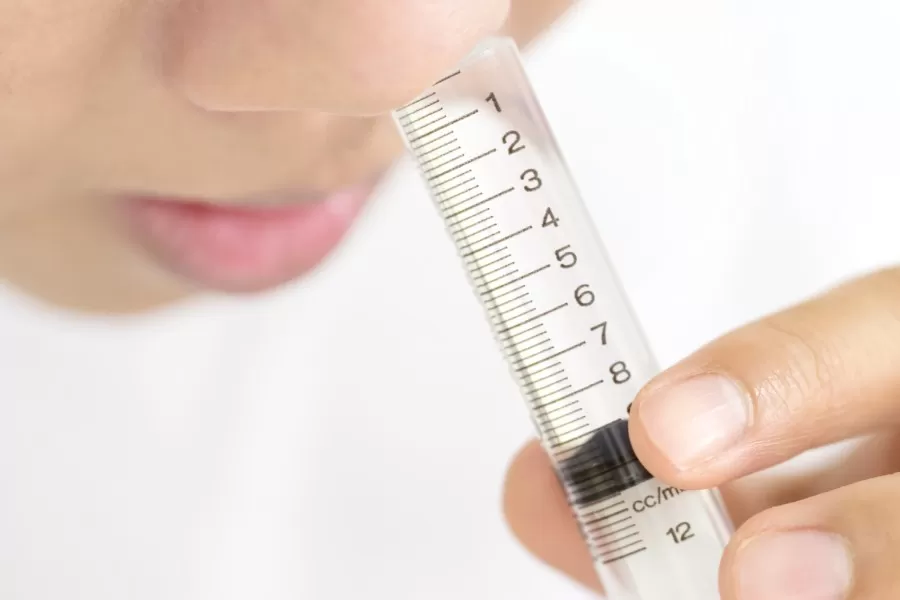
Washing the nasal cavity with water or an herbal solution is a holistic health practice that dates as far back as the 11th century. Fast forward to today and the nasal irrigation procedure, also known as a nasal lavage, has demonstrated numerous health benefits, from a reduction in the number of sick days during a sinus infection to producing a high-quality specimen ideal for respiratory tract infection (RTI) testing.
Although nasal lavage has been the preferred RTI specimen collection method for decades, nasopharyngeal swabs became the COVID-19 default due to convenience, cost and availability — putting saline washes on the back burner despite their superior sample sensitivity.
The traditional nasal lavage procedure lacked standardization, resulting in inconsistencies in specimen adequacy. But more importantly, it placed our frontline healthcare workers at risk for infection.
Knowing we needed a better way — a reimagined specimen collection method that would be acceptable to everyone — two emergency medicine specialists from the University of Nebraska Medical Center who were evaluating thousands of patients during the COVID-19 pandemic capitalized on the advantages of the tried-and-true nasal lavage procedure while modernizing it for today.
History of Nasal Saline Washes
- Ancient Times: Seaside tribes learned sniffing ocean saltwater could relieve congestion.
- 11th Century: Indian yoga instructors began teaching nasal irrigation practices. Early versions of the “neti pot” depicted on temple walls date back to this time.
- Late 1800s: Western medicine adopted and advanced the practice. Doctors experimented with technologies for in-clinic and at-home nasal irrigation.
- Mid-1900s: Nasal washes became prevalent in clinical settings for diagnosing respiratory pathogens, especially among pediatric populations.
- 2000s: Research continued to support the superiority of nasal saline washes. Prior to the pandemic, several academic studies showed nasal lavage produced higher-sensitivity samples compared to nasal swabs in patients with RTI.
- 2020: During COVID-19, nasal swabs’ scalability and convenience took precedence over the sensitivity and comfort of saline washes, making them the sampling default.
- 2025: The pandemic reignited interest in alternative collection methods in preparation for future outbreaks, including more practical versions of existing nasal lavage systems.
Shortcomings of Traditional Nasal Lavage Systems
Abundant clinical research reinforces that the nasal lavage procedure offers superior specimen quality and comfort compared to nasal swabs. Yet, several drawbacks have prevented it from becoming the specimen collection default RTI testing.
- Mess: Traditionally, healthcare professionals irrigated the patient’s nose with saline using a syringe, then attempted to recapture the effluent saline by rapidly pulling back on the syringe plunger — or worse — allowing it to free-fall into an open basin. This not only impacted sample efficacy but also increased infection risk.
- Lack of Standardization: Because the traditional nasal lavage procedure lacked standardization, the specimen adequacy varied greatly — resulting in inconsistencies in diagnostic outcomes.
- Scalability: Traditional saline lavage presented significant challenges in deployment and scalability for global pandemic response. They often required special training and equipment such as suction catheters and collection traps.
- Throughput: Traditional nasal lavage systems had a longer procedure time than swabs, reducing the number of patients tested per hour. Lower volume meant fewer people getting tested and treated.
Setting the Stage for a Better Nasal Lavage System
It’s time to think beyond the traditional nasal lavage. We must build on the existing science of nasal irrigation and elevate our approach to viral pathogen testing.
If we eliminate the disadvantages of the traditional nasal lavage and capitalize on its higher specimen adequacy, there are virtually no cons. But is it possible to achieve the best of both worlds?
Absolutely!
Welcome to Nasal Lavage 2.0 — the next evolution in RTI pathogen collection that is poised to revolutionize the RTI testing industry.
Meet Microwash.
MicroWash is the world’s first and only self-contained nasopharyngeal lavage specimen collection device to deliver consistently high specimen adequacy without the limitations of traditional methods.
- Unmatched Sample Sensitivity: Multiple, academic research studies show that nasal lavage has up to a 49% increased sensitivity for polymerase chain reaction (PCR) RTI pathogen testing compared to nasal swab specimens.
- Mess-Free: MicroWash is a self-contained device; no collection basins needed. Saline and captured specimen effortlessly drain back into the transport tube without a drop lost.
- Stockpiling: MicroWash has a 3-year shelf life, enabling organizations to economically stockpile test kits and be ready for the next pandemic.
- Consistency: The MicroWash device comes in one sleek, easy-to-use package to ensure a standardized approach to sampling no matter where, when or to whom the test is administered.
- Reimbursement: The MicroWash delivers a nasal lavage that reaches the entire nasopharyngeal and anterior nasal cavities, qualifying it for procedural (CPT) reimbursement through both Medicare and most private insurances.
Why wait for the next outbreak to take proactive virus management measures, when the reimagined nasal lavage system you’ve been waiting for is finally here?
Ditch traditional nasal saline and swabs and revolutionize URI sampling in a post-pandemic world with our groundbreaking device. Explore more advantages and contact the UMD team today.
Authors: Thang Thanh Nguyen PhD, MSN, FNP-C; Michael C. Wadman MD, FACEP and Nicholas Lorenzo, MD, MHCM, CPE, FAAPL